


Lifeline is a term frequently used when discussing occupational safety at heights. However, most people have not yet distinguished the specific cases in which they need to be used. The article below will outline the types of lifelines depending on different working environments, thereby making it easy for customers to select suitable solutions for their work requirements.
Definition
Before diving into the fall arrest system concept, let’s explore the fall protection solution according to priority order: THE HIERARCHY OF FALL PROTECTION.
Figure 1: Control measures & hierarchy of fall protection when working at heights
A lifeline is a fall protection system, including fixed anchor points (Anchorage) and cables (allowing workers working at heights to move easily over a wide area: vertically and horizontally) that are always connected with a lanyard and shock absorber between the safety harness (Body harness) and that anchor point.
The fall protection lifeline system includes:
- Mandatory components: Anchor point, Connecting line (It is recommended to use a connecting line with a shock absorber), and Full body harness.
- Rigid or fixed components: Self-retracting lifeline (SRL), vertical lifeline, horizontal lifeline, rescue equipment.
Distinguishing Working Environments Requiring Lifelines
1. Vertical Lifeline (VLL)
Vertical lifelines (VLL) are designed along ladders to ensure that as workers climb up or down the ladder, they are always connected to the anchor point (ladder). If a fall incident occurs, the worker will be caught by this system, preventing them from falling to the ground.
Figure 2: Vertical Lifeline – Fall protection system for ladders and vertical structures
Application: Vertical lifelines are installed along access ladders of buildings, towers, vertical concrete pillars, etc.
2. Horizontal Lifeline (HLL)
Horizontal lifelines (HLL) are designed on roofs or areas requiring anchor points to ensure safety when working at heights (such as cargo loading/unloading, warehouse transportation, equipment maintenance, roof cleaning, skylight panels, gutters, etc.). The system consists of anchor points fixedly installed onto the structure (such as metal roofs, purlins, load-bearing walls, etc.) and cables tensioned between those anchor points.
Figure 3: Horizontal Lifeline – Installed on roofs and overhead maintenance tracks
Application: Horizontal lifelines are installed on roofs designed according to special engineering drawings.
3. Temporary Lifeline (Rope Access/Temporary Lifeline)
A lifeline system that is temporarily installed and can move vertically or horizontally for maintenance and repair operations. After the work is completed, the system can be dismantled and reused at another location.
Figure 4: Temporary Lifeline – Portable rope access system for maintenance
Application: Temporary lifelines are widely used in outdoor repair and maintenance work, etc.
4. Working in Confined Spaces (Confined Space)
Confined space equipment allows workers to be tied off and kept safe when operating underground or in hard-to-reach, oxygen-deficient areas (used in conjunction with SCBA air supply equipment).
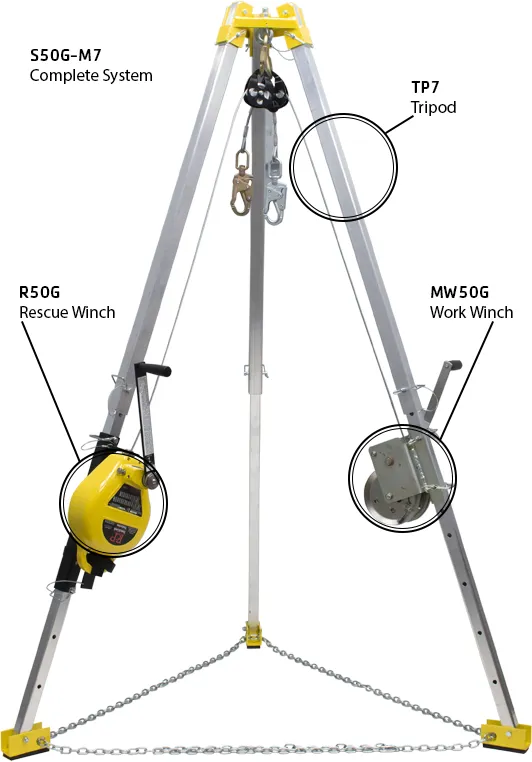
Figure 5: Confined Space Safety – Tripod setup for entry, retrieval, and rescue
Tripods are used where there is a flat surface. Used in conjunction with SCBA in case of oxygen-deficient spaces, hazardous substances, or when specific hazard levels cannot be evaluated.
All lifeline systems need to be used properly. Workers must be equipped with personal protective safety equipment such as a body harness (safety harness), lanyard (connecting line), SRL (fall arrest cable reel), Shock Absorber, etc., to connect to the lifeline system.
Source: achisonsafety.com.vn

